
Lot n° 173
Estimation :
3000 - 4000
EUR
Result with fees
Result
: 4 438EUR
Tomi UNGERER (1931-2019) - Lot 173
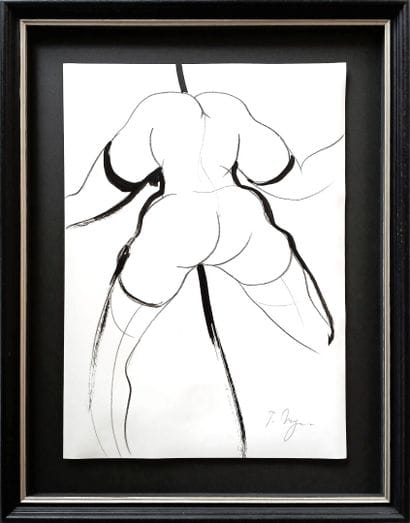
Tomi UNGERER (1931-2019)
Corps à corps
1986
India ink on paper, signed in pencil (lower right)
H_51 x W_36 cm (unframed) / H_65 x W_50 cm (framed)
Hamburg
This work is part of Tomi Ungerer's Hamburg period, during which he produced one of his best-known works: "SM, les anges gardiens de l'enfer" ("SM, the Guardian Angels of Hell"). In 1986, Tomi Ungerer spent a great deal of time in the nightlife of Hamburg's Reeperbahn prostitution district, feeding his imagination and producing erotic works. For several months, the author notes and sketches the daily life of Hamburg's "dominas", a community of sex workers specializing in sado-masochism. The project consists of portraits, interviews and a series of naturalistic drawings, focusing mainly on S&M accessories, as well as more fanciful works, such as the famous "corps à corps", which Tomi produced in several versions. At this time, the artist's graphic styles were in full effervescence and took on extremely varied forms, as evidenced by this extract from The Drawing Center's Drawing Papers volume 120, January 2015, New York:
"The same aversion to cultural norms that underlies such beloved works as The Three Brigands motivates his erotic drawings, rooted in a surprising form of humanism. Take, for example, the images of sex workers going about their daily business in Schutzengel der Hölle (Guardian Angels of Hell), a project devoted to Hamburg dominatrixes whom Tomi came to admire for the services they render to society's outcasts. [...] This desire to shake up convention informs not only Ungerer's choice of subjects, but also his highly varied style. Ungerer has described himself as an "egotistical" artist who values his own desires over good taste. Yet his approach is profoundly devoid of egotism, in that he sacrifices himself to the demands of his subjects in a way that many artists would find uncomfortable. We've already noted that Ungerer's lack of a unique, recognizable style, in the manner of Maurice Sendak or Saul Steinberg, has damaged his reputation. What are we to make of a man who creates caustic political imagery one year and moves to rural Canada, where he produces landscapes and studies of farm life worthy of Andrew Wyeth or Winslow Homer the next? How does one understand someone who concocts sweetly romantic ink wash sketches for a collection of German songs (Das grosse Liederbuch) and harsh, merciless black pen depictions of death for a volume entitled Rigor Mortis? Ungerer explained that "what counts is sending a message, and since messages are different, different styles are needed". This is certainly true. But beyond the demands of the subject, it would seem that inhabiting this space of instability constitutes a moral and political imperative for him, linked as it is to his profoundly humanist vision of the world. According to Ungerer, "my doubt is open, I say to myself: why not? Everything can be accepted, but everything must be questioned".
My orders
Sale information
Sales conditions
Return to catalogue