
Lot n° 38
Estimation :
3000 - 5000
EUR
Result with fees
Result
: 5 625EUR
FROM THE DESCENDANTS OF GEORGES SEURAT - Lot 38
FROM THE DESCENDANTS OF GEORGES SEURAT
Georges SEURAT (1859-1891)
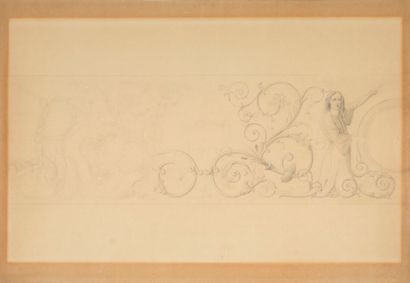
Rinceau, circa 1875-76
Graphite on wove paper
H_44 cm W_63.8 cm
Insolation of the sheet visible along the edges, and a slight tear at the bottom center.
PROVENANCE
- Léopold Appert (1867-1931), nephew of the artist.
- Then by descent to the current owner.
BIBLIOGRAPHY
- C.M. de Hauke, Seurat et son œuvre, Paris, 1961, tome II, pp. 6-7, no. 231 (the present work illustrated).
----------
SEURAT NOTICE
---
A pioneering, even legendary figure in modern art, Georges Seurat died at the age of 31 in 1891, but works by him are very rare at public auction. Today, the world's greatest museums hold the majority of the master's works, from MoMA to the Musée d'Orsay and the Tate.
Theorist and leader of Divisionism, Georges Seurat was born in Paris in 1859 into a bourgeois family. His father was a bailiff, and his mother was the sister-in-law of Paul Haumonté, a canvas merchant who would be one of the first figures guiding the young Seurat's vocation as a painter in the 1870s.
Seurat began drawing incessantly as a child. Before he was 18, he became friends with his classmate, the future painter Edmond Aman-Jean. In 1878, Seurat was admitted to the Ecole des Beaux-Arts, where he studied under the academic painter Henri Lehmann (1814-1882). Poorly regarded by Lehmann, Seurat decided with Aman-Jean and Ernest Laurent to set up their own studio in 1879. In the decade that followed, Seurat would become the creator of Divisionism, with his 1884 masterpiece, Un dimanche à la Grande Jatte, now in the Chicago Art Institute.
The present drawing Rinceau, executed when Seurat was 17 in 1876, is a frieze study that reveals the talent for academic drawing of a genius in the making. Both decorative and avant-garde, the work is already part of the avant-garde of its time. With its exaggerated vegetal curves and mysterious, timeless draped female figure, the work is in perfect harmony with the emerging aesthetics of Symbolist Art and Art Nouveau, typical of a Puvis de Chavannes or an Alfons Mucha in the making.
The present work by Seurat, preserved to this day in the artist's descendants, referenced in César de Hauke's Catalogue Raisonné and never before offered at auction, is one of the artist's last family treasures to be presented to the public. It is an important artistic and historical testimony to the pioneer of modern art, who influenced so many post-impressionist artists, from Redon and Cézanne to Luce and Signac.
Expert: Thomas Morin Williams
My orders
Sale information
Sales conditions
Return to catalogue